
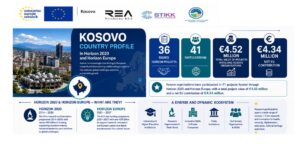
In today’s rapidly changing global economy, Research and Innovation have become the foundation of competitiveness, economic resilience, and sustainable development. Countries that successfully integrate into international innovation ecosystems are better positioned to attract investment, develop new technologies, create high-value jobs, and address complex societal challenges. For Kosovo, participation in the European Union’s research and innovation programmes represents a strategic opportunity to strengthen its knowledge economy, enhance institutional capacities, and become an active contributor to the European Research Area.
Innovation is no longer an optional pathway for economic development; it has become a fundamental requirement for countries seeking long-term competitiveness. Through engagement in European research programmes, Kosovo is gradually moving from a primarily local innovation environment towards participation in a broader European and global knowledge ecosystem.
Horizon Europe: A Strategic Opportunity for Kosovo
The European Union has placed research and innovation at the centre of its future development agenda, continuously increasing investment in scientific excellence, technological advancement, and societal transformation.
The previous EU Framework Programme, Horizon 2020 (2014- 2020), with a budget of nearly €80 billion, created one of the largest collaborative research environments in the world. It supported thousands of projects across areas such as health, digital technologies, climate change, energy, advanced manufacturing, and sustainable development, establishing strong foundations for international cooperation.
Building on this success, Horizon Europe (2021-2027) represents an even more ambitious investment in the future of European innovation. With a budget exceeding €93 billion, it is the world’s largest research and innovation programme, designed to accelerate Europe’s green and digital transitions, strengthen industrial competitiveness, and support solutions to major global challenges.
For Kosovo, Horizon Europe provides an important gateway to European scientific networks, enabling local organisations to collaborate with leading European institutions, access international expertise, and contribute to innovative solutions with global impact.
Kosovo’s Growing Participation in Horizon Europe
Kosovo’s participation in Horizon Europe has steadily evolved over recent years, reflecting the country’s growing research capacity, increasing institutional readiness, and deeper integration into European collaborative networks. While Kosovo remains a developing participant within the European Research Area, the progress achieved represents an important milestone in strengthening its innovation ecosystem and international research profile.
To date, Kosovo has achieved significant progress, including:
- 36 signed Horizon Europe projects involving organisations from Kosovo;
- 41 total participations in European research and innovation consortia;
- More than €4.5 million in total project value involving Kosovo organisations;
- Growing participation across multiple sectors, including universities, research institutions, innovative SMEs, public institutions, civil society organisations, and innovation support organisations;
- Expanded international collaboration with European partners through joint research and innovation initiatives.
Although these figures remain modest compared to larger European economies, they demonstrate a positive development trajectory and highlight Kosovo’s gradual transition from an emerging participant towards a more active contributor within Europe’s knowledge and innovation ecosystem.
The increasing engagement confirms that Kosovo’s research community and innovation actors are developing the experience, partnerships, and capacities required to compete for larger and more ambitious European-funded opportunities.
A Diversifying Innovation Ecosystem
One of the most encouraging developments in Kosovo’s Horizon Europe journey is the diversification of participants. In the early stages, European research programmes were often associated primarily with universities and academic institutions. Today, Kosovo’s participation reflects a much broader innovation ecosystem.
Universities and higher education institutions continue to play a crucial role, but they are increasingly joined by research centres, innovative SMEs, public institutions, civil society organisations, and innovation support organisations. This wider involvement demonstrates that research and innovation are becoming embedded across different sectors of society.
This transformation is particularly important because innovation creates the greatest impact when knowledge moves beyond research laboratories and is translated into practical solutions. Through Horizon Europe projects, Kosovo organisations are contributing to areas such as digital transformation, entrepreneurship, sustainability, cultural heritage preservation, public services, and technological development.
The participation of businesses and innovation-driven SMEs is especially significant, as it creates stronger links between research and the market. By engaging in European projects, companies gain opportunities to develop new products, test innovative solutions, establish international partnerships, and strengthen their competitiveness.
The Coordination Gap: Kosovo’s Next Strategic Challenge
Despite the progress achieved, Kosovo’s participation in Horizon Europe also highlights an important strategic challenge: while organisations from Kosovo have successfully joined international consortia as partners, no Kosovo-based organisation has yet coordinated a Horizon Europe collaborative project.
This represents a critical next step for the country’s research and innovation ecosystem.
Project coordination is considered the highest level of participation within Horizon Europe. Coordinators are responsible for shaping the project vision, leading international partnerships, managing implementation, overseeing financial resources, and representing the consortium before the European Commission.
Becoming a coordinator brings significant strategic benefits. It increases institutional visibility, strengthens international reputation, develops management capacity, and allows organisations to influence European research priorities rather than simply contribute to predefined agendas.
For Kosovo, the transition from project partner to project leader should become a central objective for the coming years. Achieving this ambition will require continued investment in research excellence, stronger institutional capacities, improved proposal-writing skills, and greater confidence among local organisations to lead complex international initiatives.
Horizon Europe as a Gateway for Business Competitiveness
The importance of Horizon Europe extends beyond research institutions. For Kosovo’s private sector, particularly innovative SMEs and start-ups, European research programmes provide a pathway towards international growth and market competitiveness.
Participation in Horizon Europe allows companies to:
- Develop new products and innovative solutions through collaboration with European experts;
- Accelerate internal research and development capacities;
- Increase international visibility and credibility;
- Attract investors and establish strategic partnerships;
- Access European knowledge networks and best practices;
- Strengthen readiness for participation in the European Single Market.
For sectors such as information and communication technologies (ICT), clean technologies, advanced manufacturing, agriculture technology, and digital services, Horizon Europe represents a valuable opportunity to move from local market activities towards international expansion.
Innovation-driven companies that successfully engage in European projects gain not only financial support but also access to expertise, networks, and market opportunities that can significantly accelerate their growth.
Enterprise Europe Network Kosovo: Connecting Kosovo with European Opportunities
The complexity of participating in European research programmes remains one of the main barriers for many organisations. Identifying suitable funding opportunities, finding international partners, developing competitive proposals, and managing European projects require specialised knowledge and experience.
This is where the Enterprise Europe Network (EEN) Kosovo plays a strategic role in supporting Kosovo’s innovation ecosystem.
Coordinated by Prishtina REA, together with consortium partners, EEN Kosovo serves as a bridge between local organisations and European innovation opportunities. Through its services, the Network supports SMEs, universities, researchers, entrepreneurs, and public institutions by helping them identify relevant opportunities, build international partnerships, participate in matchmaking activities, and strengthen their innovation capacity.
Through activities such as partner searches, brokerage events, international networking, advisory services, and innovation support, EEN Kosovo helps reduce barriers to European participation and increases the ability of Kosovo organisations to engage successfully in international programmes.
By connecting local ambition with European expertise, EEN Kosovo contributes directly to strengthening Kosovo’s innovation ecosystem and supporting innovation-led economic growth.
The Future: Emerging Technologies and New Opportunities
The next stage of Kosovo’s innovation development will increasingly depend on participation in high-impact research areas that are shaping Europe’s technological future.
Emerging fields such as Artificial Intelligence (AI), cybersecurity, clean energy, climate resilience, advanced manufacturing, digital transformation, health technologies, and the circular economy represent significant opportunities for Kosovo’s researchers, entrepreneurs, and institutions.
Success in these areas will require stronger cooperation between academia, business, government, and innovation support organisations. It will also require continued investment in skills development, research infrastructure, entrepreneurship, and international collaboration.
Kosovo has important advantages that can support this transition, including a young and digitally skilled population, a growing technology sector, entrepreneurial potential, and increasing experience in international cooperation.
The next phase, however, will require greater ambition. Success will not only be measured by the number of projects secured but by Kosovo’s ability to lead European research initiatives, coordinate international partnerships, and transform innovation into economic and social impact.
With continued investment in research capacity, stronger support for innovative businesses, and strategic mechanisms such as Enterprise Europe Network Kosovo, the country has the opportunity to move from participation towards leadership.
In an era where innovation defines competitiveness, Kosovo’s integration into European research and innovation programmes represents not only an opportunity for funding but a pathway towards a more competitive, sustainable, and knowledge-driven economy.